


In 1985, Klier began to conduct research and surveys on the childcare and education system in the GDR, believing that the roots of the dictatorship were to be found there. The results of her surveys of young people and, from 1986, of teachers as well, painted a picture of a society shaped by dishonesty, depression and hopelessness. However, they also indicated that the limits of the state’s ideological influence had been reached and that most young people in the 1980s were resistant, at least internally, to the SED’s attempts to win them over. This research informed her well-received book “Lüg Vaterland. Erziehung in der DDR” (Lie fatherland. Education in the GDR), which was released in 1990.
Klier disseminated the results of her research in samizdat publications and also presented socially critical prose texts and plays in readings held in churches and private homes. The Ministry of State Security (Ministerium für Staatssicherheit, MfS) kept her and Stephan Krawczyk under observation in operation “Sinus”. In addition to the harassment in their professional lives, both were the victims of extensive Stasi social/psychological “decomposition” methods (Zersetzung), which put a psychologica strain on Klier.
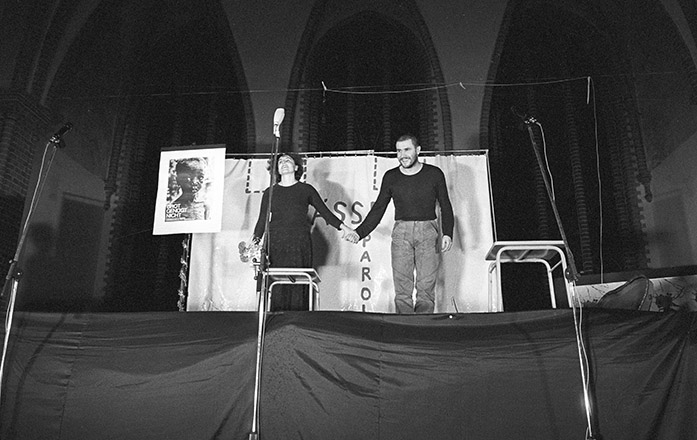
Freya Klier and songwriter Stephan Krawczyk at the performance of their play “Pässe und Parolen” (Passports and slogans) in East Berlin’s Samariterkirche on 13 November 1986.
Klier took a critical view of the Churches and of many of the grassroots opposition groups, although she did join “Solidarische Kirche”, an opposition group that was trying to build up a network to support contact among groups throughout the country, in October 1986. Based on her own experiences, she believed the opposition groups to be lacking in solidarity, and she complained that the groups were not radical enough in their thinking or action. For this reason, Klier is not strongly associated with group contexts, although she was in close contact with key opposition figures. She used her frequent travel around the country to actively promote the nation-wide networking among opposition groups and individuals.
In November of 1987, Klier and Krawczyk sent an open letter to Kurt Hager, the SED’s chief ideologist. The letter, widely read in the GDR, and also published in the West German media. It criticised conditions in East German society and called for extensive reforms. Also in late 1987, the two had decided that they would part in the official march honouring Rosa Luxemburg and Karl Liebknecht, an annual event held in January carrying banners with slogans taken from Luxemburg’s writings. They intended to draw attention to problems in society as well as to their own occupation ban. Learning that many would-be emigrants planned to take part in the demonstration on 17 January 1988, Klier decided that she herself would not do so, because she did not want to conflate her own concerns with the justified demands of the would-be emigrants.
Pulling out before the event did not change the outcome though, as the MfS had already been meticulously planning their operation “Troublemaker” for weeks. Their first move was to arrest the actual participants – about 160 people in total – including Stephan Krawczyk, Vera Wollenberger and Herbert Mißlitz. Freya Klier immediately reached out to artists in West Germany with an appeal asking them to express their solidarity by refusing to perform in the GDR. Within a matter of days, though, the MfS made more arrests, including several of the leading opposition figures, Freya Klier, Regina and Wolfgang Templin, Werner Fischer, Bärbel Bohley and Ralf Hirsch among them. The SED media launched a smear campaign against those who had been arrested; declarations of solidarity in various forms poured out from the opposition in East Europe and from West Germany, though some leading West German politicians expressed understanding for the measures. East Germany saw the largest wave of solidarity with political prisoners since 1953. The prisoners themselves knew nothing of this, however. Their lawyers were unofficially working for Stasi and did not tell them what was really going on, even going so far as to claim that no one on the “outside” was interested in their fate. Freya Klier and Stephan Krawczyk decided to leave the GDR rather than risk multiple-year prison sentences. The other opposition figures who had been arrested also left the GDR – under a variety of conditions. When they arrived in West Germany, they realised that they had been tricked. Though they explained that they had only agreed to leave the GDR under duress, some of the key left-wing opposition figures in the GDR branded them traitors.
Klier has lived in West Berlin since she lost her East German citizenship, and she continues her work as an author, director and filmmaker. She has published a wide range of works, on topics ranging from the history of communism and overcoming it, to the Nazi dictatorship and beyond. She is also still active politically and in civic education: She regularly giving talks for schoolchildren and is a founding member of the Citizen’s Bureau (Bürgerbüro e.V.), an initiative in Berlin that advises and supports victims of the SED system and carries out projects of its own aimed at advancing the understanding and acknowledgement of GDR history.