


In the late 1990s, Reinhard Schult lived with his partner and their two children in a tiny village in the Uckermark called Fredersdorf (now part of Zichow). Five nights a week, he worked behind the bar in the local pub, “Zur Linde”, where the pub’s patrons would pass along the latest news from the village. The local farmers had quickly come to trust the newcomer from the city, even going so far as to elect him deputy mayor of the small community (population: 140) in 1998. In addition to serving in this unsalaried office, he minded the poultry and sheep at his farm, grew fruits and vegetables and worked on improvements to his ca. two-hundred-year-old half-timbered home. Someone seeing him in his work clothes between the chicken coop and the vegetable bed might have been reminded of a plebian tribune or Emperor Diocletian, who retired to Dalmatia to grow melons, disgusted by the immoral goings-on of the Romans.
However, anyone who sees in Schult a man driven to self-exile by frustration and resignation has failed to understood the essence of the GDR opposition. The opposition was never about political posts or careers. It was not even about politics in the narrow meaning of that word: it was about saying no and about self-respect. “The opposition in the GDR was a small opposition,” wrote Reinhard Schult in 1995, looking back on those years. “Everyone knew nearly everyone else. None of us thought we could bring down the SED regime. The point was to let more air into this musty GDR, get a little more room to move within the straitjacket. We were an infinitesimal minority – without backing in the population.” And Reinhard Schult was one of the dinosaurs of the GDR opposition, there when it first took shape, under the protective umbrella of the Evangelical Church in the 1970s.
From his earliest childhood, it was obvious that Reinhard Schult, born in Berlin in 1951, would end up in conflict with the GDR authorities. His mother worked as a nurse at the hospital in Kaulsdorf, the district on the Berlin’s eastern edge where the family lived. The family’s bags were already packed for their move to the West when the Wall was built; their tickets for the flight from West Berlin were already purchased. Long after the jaws of the trap had swung shut, the family was still trying to come up with a plan that would get them to West Germany, where they had numerous relatives. Even as a school pupil, Reinhard Schult was already seen as “pro-Western”. He preferred the banned Mickey Mouse comics to the Pioneer magazine “Trommel”.
Schult did not have to endure the drawn-out parting with the state ideology, the clashes and ruptures with their parents or the agonising process of extricating themselves from the arms of the Party that was so many of the GDR’s critically minded intellectuals went through. In the Young Congregation (Junge Gemeinde) in Berlin’s Mahlsdorf district, he found an understanding pastor who was doing interesting work with youth. Schult persuaded his entire class, including the FDJ secretary, to attend a church event as a group, thereby triggering the first of the many scandals he would be involved in. In his twelfth year of school, he withdrew from the FDJ and then refused to serve when called in for the examination of his medical fitness for military service. Had he been attending an extended secondary school, he would have been out on his ear, but the company vocational school of the residential building enterprise in Berlin’s Oberschöneweide did not take quite such a grim view of such things . Schult was able to pass the test qualifying him as a masonry specialist and get his upper secondary school qualification there in 1971. He began to study theology at the Protestant theological college (Sprachenkonvikt) in Berlin. Within a few months, he had realised that this was not the right place for him either. By now the father of young children, he took a job in construction, work which paid quite well by the standards of the time.
In 1976, Schult was conscripted for 18 months of service as a “construction soldier”. Once discharged, he began to get involved in opposition circles and groups. He performed with friends in churches, singing songs and reading texts by Wolf Biermann, Reiner Kunze and other writers. Then, in 1979, an acquaintance was arrested while attempting to leave the GDR. Under interrogation, this person told the Stasi that Schult had been aware that he was preparing to escape, whereupon Schult was arrested on the charge of abetting “desertion from the Republic”. Schult’s acquaintance withdrew the incriminating statements in court, leaving the fuming public prosecutor with only a “public defamation” charge. Schult was sentenced to eight-months incarceration for possessing an edition of “Roter Morgen”, the magazine of the West German Communist Party of Germany/Marxists-Leninists and texts by Wolf Biermann. No lesser sentence was possible, as he had already spent that much time in pre-trail detention.
Upon his release, it was suggested to him that an application to leave the GDR would have a good chance of receiving quick approval. But Schult no longer wanted to go. He threw himself into the activities of the peace and environmental groups, which were flourishing, attended the peace seminar in Königswalde in 1980, organised discussion forums with former construction soldiers at which people were encouraged to refuse armed military service, worked in the peace group of the Evangelical Student Union (Evangelische Studentengemeinde), started a group to discuss the history of the KPD and a Karl Marx group. He joined the opposition group “Gegenstimmen” (meaning votes against/dissenting voices) in 1985, and the Church from Below (Kirche von Unten, KvU) in 1987. In those days, few people in the opposition worried about mixing bits of Christian and radical left-wing ideologies. The act of expression was more important than theoretical rigour.
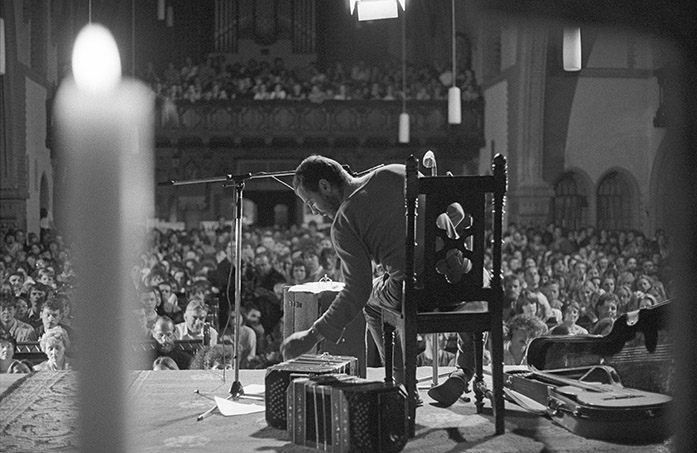
Accusing the official Church of doing too little to resist state interference and control, peace groups and members of the Church from Below hold their own “Church congress from below” during the Church congress in 1987. Desiring consensus, the Church leadership tolerated the concert given by Stephan Krawczyk, who was under a performance ban. The photograph was taken at his concert on 27 June 1987 in the packed Samariterkirche in East Berlin’s Friedrichshain district.
On 7 May 1989, Schult was actively involved in organising the nation-wide effort to document election fraud. He was also one of the original 29 signatories of the proclamation “Aufbruch 89” (Initiative 89) of the New Forum (Neues Forum) on 9 September. In the months that followed, he sought to uphold the ideals of direct democracy within the New Forum. He became a familiar figure throughout the country thanks to the television broadcasts of the meetings of the Central Round Table and through numerous other public appearances. Consistently grumpy and ill-humoured, he had a way of making cogent points in Berlin working class slang that punctured the harmonious flummery of the old guard.

Working meeting of the New Forum in the East-Berlin flat of Bärbel Bohley, 29 October 1989: the photograph shows Bärbel Bohley, Reinhard Schult, Michael Kukutz, Eberhard Seidel, Andreas Schönfelder, Hans-Joachim Tschiche, Jutta Seidel, Jens Reich and one other person.
Schult was part of the group that organised the demonstration at the Stasi headquarters in Ruschestraße on 15 January 1990 that ended in the occupation of the complex. In the months that followed, he represented the New Forum in the Security Working Group, which monitored the dissolution of the Ministry for State Security (Ministerium für Staatssicherheit, MfS). After the free elections to the Volkskammer in March of 1990 and the creation of a State Committee for the Dissolution of the State Security Service under the oversight of the new interior minister, Peter-Michael Diestel, Schult formed a group of his own within the agency that sought to keep the spirit of the Citizens’ Committee alive.
In the months leading up to reunification, he and others began to see indications that the West German bureaucracy and the old-boy networks of the GDR were arriving at a symbiotic relationship with respect to the question to deal with the legacy of the GDR’s Stasi. People like Schult disturbed this new concord. In Schult’s case, actively and rigorously. When news got out about the new federal interior minister’s plan to move the MfS archives to the Federal Archives in Koblenz where they would be kept under lock and key, Schult and his group responded with a symbolic occupation of some of the rooms at the Stasi archives. The police barricaded the premises and prepared to storm the rooms. Once again, opposition figures were facing off against the power of the state. The same old uniforms and the same old squads, only this time they were under the orders of the CDU interior minister, Diestel. Tensions were eased by a visit by the Volkskammer president, Sabine Bergmann-Pohl, to the site. The occupiers began a hunger strike aimed at keeping the records in the GDR. Schult and some friends showed up at the plenary hall while the Volkskammer was debating the issue. He stood there amid the storm of flashbulbs, unshaved, and gaunt from the hunger strike. With the public eye now firmly fixed on it, the GDR’s legislature decided to retain the records in Berlin and appoint a Federal Commissioner for the Records of the State Security Service. This turned out to be the last great success of the civil movement.
Schult was elected to Berlin’s Parliament on 2 December 1990 as a candidate on the Alliance ‘90/Green Party list. By this time, the group of GDR civil rights activist had shrunk to a small, consolidated core. Splitting from the Alliance ‘90/Greens parliamentary group, they formed their own group, which they called the “New Forum/Civic Movement” (Neues Forum/Bürgerbewegung). In 1995, at the end of the legislative term, Schult became unemployed and eventually to apply for social assistance. There are no pension or unemployment provisions for rebels. Schult knew this all along and has never complained.
With five decades of political activism behind him, Reinhard Schult had no intention of stopping his work. He worked with right-wing extremist youth, occasionally wrote pieces for newspapers, was present in the media and had moved to another village, near Bernau outside of Berlin, to get another farm up and running. He was a member of the working committee of the New Forum Berlin and worked as a citizen’s advisor at the office of Ulrike Poppe, the commissioner the Land of Brandenburg charged with furthering the understanding and acknowledgement of the consequences of communist dictatorship. His cause was then merely a shadow of the broadly based popular movement it once had been, but this did not worry him much. He stood with the people – even if he was standing alone.
Reinhard Schult was honored for his commitment with the German National Prize in 2000 and the Federal Cross of Merit in 2014. He died after a long and serious illness on 25 September 2021.