


In March 1983, Jahn, together with Thea and Michael Rost, Andreas Friedrich, Ute Hinkeldey and some others, founded the Jena Peace Community (Friedensgemeinschaft). This group, which was not affiliated with a church, was the first to present itself to the public as an opposition group actively and with obvious intent. The document in which the group set out its basic aims and objectives, written in a Christian-pacifist vein, borrowed from the tradition of the French bourgeois revolution: “What we want: peace among people as a condition necessary to life, as freedom, equality, fraternity” adding “with the renunciation of violence”. On 18 March 1983, the Jena Peace Community turned out at an official demonstration in remembrance of the 1945 bombing raid on Jena carrying their own posters. They did the same thing at the official peace demonstration held by the Free German Youth (FDJ) on 19 May 1983, which was intended as a protest against NATO’s missile deployments only. Jahn and his friends carried banners with slogans like “Disarmament in East and West”, “Militarisation out of our life”, “Swords to ploughshares”, “Renounce violence”, “No future without peace”. State Security organised a response intended to look like public outrage: civil servants beat the demonstrators, tore Jahn’s banner his hands and destroyed it. They couldn’t prevent the photographs of these demonstration and the actions of the MfS from being released in the West German press though or from making their way back to East Germany in this form. The activities in Jena influenced the growing independent peace movement throughout the country.
On 22 May 1983, Jahn went to the central FDJ rally in Potsdam carrying a poster reading “Swords into ploughshares”. The poster was seized, Jahn was beaten and arrested. A few days later, on 8 June, the thugs in power decide to throw him out once and for all. He managed to slip away long enough to get word to some friends at one point, after which chain twister was put on his wrists to prevent another escape. At the train station at the border, he was placed on a train bound for West Germany and chained to his seat. This forced deportation to the West caused the biggest sensation created by such an event since Wolf Biermann’s citizenship had been revoked.
Jahn wanted to return to the GDR. He wrote a letter to the GDR’s head of state Erich Honecker, and had an appeal handed personally to the UN Secretary General, but to no avail. The silver lining in those early days in the West was getting to see his daughter and some old friends. An illegal trip to Jena in 1985 helped put his romanticised views of the GDR in perspective. The East Berlin opposition figures whom he met on his return trip encouraged him to stay in the West, telling him he could do more for their cause from there.
Roland Jahn was one of the most important supporters that the GDR opposition had in West Germany, along with Jürgen Fuchs, who sometimes acted as his partner. Both of these men repeatedly urged the human rights issue: in the West German debate over the relationship with the GDR, Jahn constantly pointed out that the issue was not humanitarian relief for the GDR’s population but their human rights. He acquired copying equipment and printer’s matrices, video cameras, computers, books and newspapers and arranged for them to reach the right people in the GDR. Jahn also put members of the GDR opposition in touch with Western politicians, journalists and diplomats. He systematically collected information about the resistance in the GDR and educated people in the West about the situation there. Jahn worked as a freelance journalist for the East-Berlin page of the West-Berlin daily “Tageszeitung” and for the television magazine “Contrast” and he also arranged for “Radio Glasnost” a programming airing pieces by East German critics of East German society to be broadcast by “Radio 100”, a private broadcaster in West Berlin. With the support of Rüdiger Rosenthal, Jahn operated, more or less privately, a successful news agency from mid-1987 onwards.
From his base in West Germany, Jahn was involved in all of the important events leading up to the autumn of 1989. He was one of the few to recognise and support the revolutionary potential of the emigration movement and, in the summer of 1989, of the new citizens movement and parties. He discussed the political situation and devised strategies in countless telephone conversations with East-German critics of the regime. In his reports in the media, he usually used the pseudonyms “Jan Falkenberg” and his writing found its way into the living rooms of East German homes under that name.
Those in power in the GDR recognised Jahn as their “primary enemy” and planned to continue to persecute him in the West. Informers were placed around him, agents listened in on his telephone conversations day and night. The MfS tried to use their social/psychological decomposition measures (Zersetzung) to damage Jahn’s reputation and reduce his influence. Among other things, they falsely accused him of working for the West German secret service. Although he lived in West Berlin, the GDR justice authorities issued an order for his arrest on the grounds of “treasonable transmission of information” on 22 December 1987. His persecution did not cease until 12 December 1989.
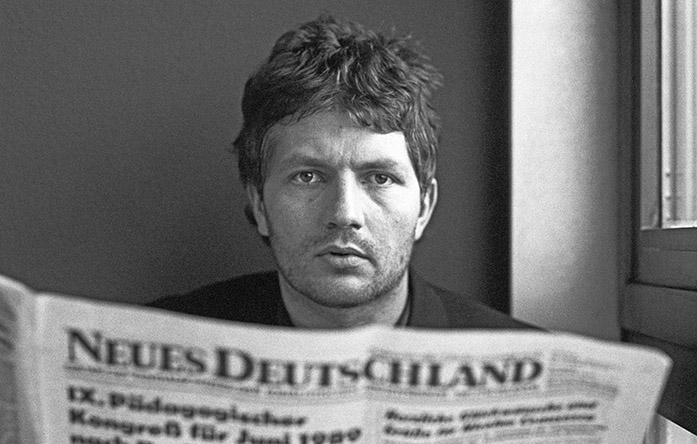
Roland Jahn in West Berlin on 26 January 1988.
After the fall of the Wall, Jahn was involved in the dissolution of the MfS unit responsible for the administrative district of Gera. As a journalist, he covered the dissolution of State Security in Berlin and wrote about how society was grappling with the realities and legacies of the SED dictatorship and continued to do so after German reunification. In 1991, Jahn took up a permanent position with on the political magazine-style radio show “Kontraste” aired by the broadcaster Sender Freies Berlin. In 2011, the German Bundestag voted to name Roland Jahn to succeed Joachim Gauck and Marianne Birthler as the Federal Commissioner for the Records of the State Security Service.