


Thomas Ammer was born in the Thuringian town of Eisenberg in 1937. His parents owned their own business, manufacturing reproductions of historical keyboard instruments. Ammer's father, who had only served only for a few months in World War II due to health problems, had ties to illegal cells of the German Communist Party (KPD) during the Nazi dictatorship. He was personally involved in their activities from 1943 through 1945 and joined the KPD after the war, but died soon afterwards, in January 1946.
Ammer's first clashes with the SED regime occurred while he was still in school. From the summer of 1952 to the spring of 1953, the SED waged a campaign against the Youth Congregation (Junge Gemeinde) of the Evangelical Church. Its members were harassed and bullied in schools and universities; thousands were expelled. Ammer tried in vain to use his position as secretary of the Free German Youth organisation to defend those of his classmates who became targets. This, along with the formative experience of the uprising of 17 June 1953, destroyed the initial respect that Ammer's anti-fascist convictions had led him to accord to the GDR. The only demonstration in Eisenberg during the uprising was a peaceful protest attended by several hundred people, but the news and debates about the protests in other parts of the country opened Ammer’s eyes to what was happening in the country.
During this period, the first informal discussion groups formed at his secondary school. In the autumn of 1953, the group that would go down in the history of resistance in the GDR as the Eisenberg Circle (Eisenberg Kreis – this name began to be used for only after its heyday) began to form. Thomas Ammer, Reinhard Spalke and Johann Frömel were the initiators of this group. They were later joined by Peter Herrmann, a student of mathematics, who brought in a resistance group of his own. Initially, there were about a dozen members of this group, which was made up of school and university students, apprentices and young workers. They represented a wide range of political convictions: the group encompassed social democrats, Christians, conservatives and Marxists.
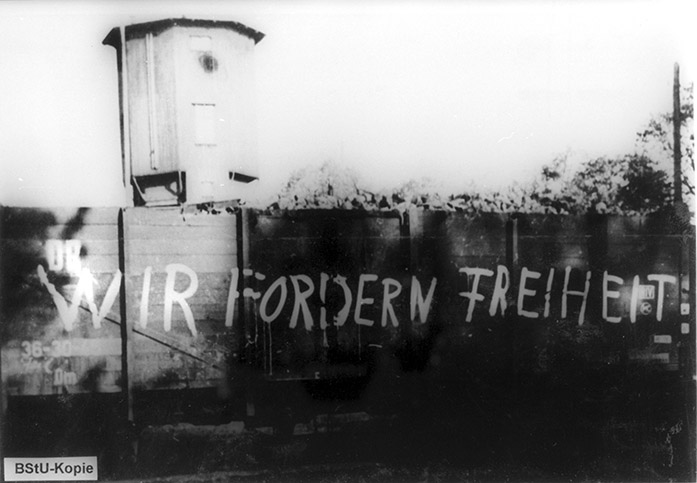
The resistance group known as the Eisenberg Circle was active in Thuringia in the 1950s. Its members made their demands publicly, including many demands of a political nature, such as that shown in this photograph, taken on 21 October 1956 at the Hainspitz train station near Eisenberg: “We demand freedom.”
Unlike other resistance groups, this group had no fixed hierarchy, no governing body and no plenary meetings. Instead, it concentrated on strictly clandestine operations. Taking its cue from the system of illicit cells used in the resistance against the Nazis, the group structured itself such that its members did not necessarily know one another, and no more than four or five members would attend any given meeting. Ammer belonged to the small, informal cadre of the group's leaders right from the start and as such was one of the few people who knew how many members the group had and who they were. Members tried not to draw outside attention to themselves and to appear to be as conformist as possible. Ammer himself, for instance, continued to serve as a functionary of the Free German Youth (Freie Deutsche Jugend, FDJ) even after he had finished secondary school and begun to study medicine at the University of Jena in 1955.
The group's thinking about objectives, strategies and resistance activities grew clearer over time. They called for free elections, the withdrawal of the Soviet occupying forces, the release of political prisoners, freedom of the press, the recognition of opposition parties and an end to political trials. The group also began to engage in debate about forms of ownership in the economy or about the effectiveness of workers councils. Activities ranged from distributing handbills and appeals, to painting political slogans on the walls of buildings or freight cars (1956 “Freedom for Poland”) to tearing down banners and beyond. The group carried out an arsonist attack at a firing range belonging to the official paramilitary youth organisation “Sports and Technology Society” (Gesellschaft für Sport und Technik) in January of 1956 and changed the name of the passenger ship “Stalin” to “Bayern”. However the scope of the group’s activities was very limited by its strictly clandestine nature and significant financial constraints – it had only sporadic contact with West German agencies. Not infrequently, its leaders had to call off operations to avoid endangering the group or individual members, sometimes after considerable preparations had already been made. While the Eisenberg Circle welcomed the 1956/1957 upswelling of student opposition to the regime at many of the GDR’s universities, including that in Jena, the group itself did not become involved in the activities associated with it due to its clandestine nature, though some of its members certainly were involved. Thomas Ammer, for instance, as a member of the FDJ leadership at the university, was able to draw up secret reports on its meetings which could be smuggled to the West and published if a need arose. One report recorded Kurt Pätzold as saying that at most 150 of the 6000 students in Jena in 1956/57 supported the SED. Pätzold was then SED party secretary at the university and later an influential historian and researcher on fascism, and frequently played a role in the political persecution of students right up until the end of the GDR.
The group was exposed in early 1958 when a member betrayed it. Thomas Ammer was arrested by State Security on 13 February 1958. By April, the Stasi had arrested 24 young men for being members of the Eisenberg Circle; five were able avoid imminent arrest by escaping to the West. In September and October of 1958, the Gera District Court sentenced 24 persons to a total of 114 years and 6 months of penal servitude. Thomas Ammer received the most severe sentence, 15 years of penal servitude for treason, on 27 September 1958.
Before being sentenced, Ammer was held at the Ministry of Security (Ministerium für Staatssicherheit, MfS) detention centre in Gera, afterwards he spent several weeks in the notorious Waldheim prison before being transferred to the Brandenburg-Görden prison, where he remained from November 1958 to 1964. After spending the final week of his more than 6 years in prison at the Stasi detention centre in Berlin Lichtenberg, he was released to West Germany on 14 August 1964.
Ammer owed this early release to the efforts of the West German government, which began paying the GDR for the release of political prisoners in 1963. Ammer was one of the first prisoners to be “ransomed” in this way. In total, around 32,000 of the estimated 250,000 persons imprisoned on political charges in the GDR found their way to the West through this channel. This modern-day form of human trafficking boosted the GDR’s foreign currency balance by 3.4 billion West German marks.
Once in the West, Thomas Ammer studied political science, law and history at Tübingen, Bonn and Erlangen. He later worked as an editor for a magazine based in Switzerland as well as at the Institute for Society and Science in Erlangen. A member of the German Social Democratic Party (SPD) from 1968 to 1982, Ammer was subject to persecution and observation by the GDR’s MfS even after moving to West Germany. He did not return to the GDR until after the fall of the Wall. State Security had imposed a permanent entry ban on him, in part because the GDR continued to be a focus of his scholarly, journalistic and political activities.
In 1975, he became a member of the research staff at the Federal Institute for All-German Affairs (Gesamtdeutsches Institut Bonn), where he worked until the institute was dismantled in 1991. From 1991 until his retirement in 2002, he worked at the Federal Agency for Civic Education (Bundeszentrale für politische Bildung, bpb), from which he was twice seconded to secretariats of inquiry commissions of the German Bundestag, on “the history and consequences of the SED dictatorship” (1992–94) and “overcoming the consequences of the SED dictatorship in the process of German unity” (1995–98).
While the Eisenberg Circle achievements necessarily remained on a modest scale, due to the nature of the group, the protest articulated by it and by Thomas Ammer personally sent an important anti-dictatorship message into society. Long after the fact, in 1998, Thomas Ammer received a Cross of Merit of the Federal Republic of Germany in recognition of his struggle for democracy, freedom and the rule of law.
Thomas Ammer died on 11 October 2024 in Euskirchen.