


Before long, thematic workshops, first as a new form of religious services designed by participants and a cultural alternative, were being held in various cities in the southern part of the GDR. In the late 1970s, Schilling and Pastor Uwe Koch worked with young people from the region to organise large-scale events in Rudolstadt. Attended by 1,000–2,000 people, these events were the forerunners of the Berlin Blues Masses of Rainer Eppelmann: “JUNE 78” on the apartheid/exclusion with the slogan “Trust yourself and the other to achieve something” and "JUNE 79" on the UN’s International Year of the Child. The state banned these activities in 1980, and the retreat in Braunsdorf was closed for good in October of that year (the authorities had already tried to close it once before, in 1974, when Schilling had been replaced as leader of the home under state pressure). This time around, structural defects in the building provided the pretext for the closure. The retreat building could not be renovated until after the demise of the GDR, though this was partly due to the shortages that plagued the GDR economy.
Schilling had been under observation by the Ministry for State Security (Ministerium für Staatssicherheit, MfS) since the 1950s, initially because he was a non-voter. Stasi officers showed up at his home when he began to interfere in youth policy in 1963 and criticised new legislation. Having noted his critical distance from SED policy, they launched a series of operations focussing on him (operations “Reactionary”, “Poster” and “Spider”), the records of which were partially destroyed by MfS officials during the Peaceful Revolution of 1989, in their rush to dispose of incriminating material. The Stasi employed some of their social and psychological “decomposition” methods (Zersetzung) against Schilling, focussing mainly on his transregional activity; they also tapped their unofficial collaborators in the church leadership to keep them informed about his doings in this area. Five of the nine members of the ruling body of the Church were MfS informers. Walter Schilling found a listening device in his parish home in 1984.
That Schilling was in contact with such a wide range of people is probably the main reason the MfS was suspicious of him. But what most annoyed the Stasi officials was probably his foiling of their intrigues. Schilling had been warning young people against letting themselves be drawn in by the MfS since 1956 and had kept some from being recruited as informers. Again and again, he broke the taboo and spoke openly about the fear-laden topic of the State Security service, even holding previously announced lectures on the subject at Young Congregations in Thuringia from 1986 onwards.
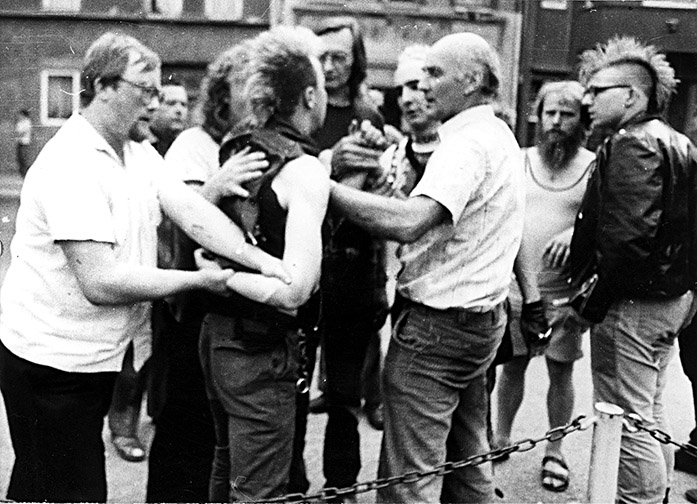
A punk youth being arrested by State Security in the area of “JUNE 86” (20–22 June 1986), an event for young people organised by Walter Schilling and Pastor Uwe Koch in Rudolstadt. Schilling (in the middle, partially concealed) is trying to help the young man.
After the retreat was closed down, Walter Schilling became more active in transregional activities. In 1981, for instance, he and others from Open Work compiled a 60-page report documenting human rights violations. The report confronted the Church leadership with the bitter reality of the state’s treatment of critical youth. At around the time that Matthias Domaschk, a young man from Jena, died while in Stasi custody at a detention centre in Gera, the police had conducted a brutal raid at the flat-warming party of Schilling’s daughter Kathrin in Berlin.
In 1982, Schilling and some of his fellow pastors founded the Altendorf Peace Group (Altendorfer Friedenskreis); he also took part at the meetings of the peace network “Frieden konkret” and of grassroot groups in Thuringia. In 1986, he signed the submission to the SED Congress drafted by the Initiative for Peace and Human Rights (Initiative Frieden und Menschenrechte, IFM). That same year, he was able to hold a workshop in Rudolstadt again. He played a leading role in the “Church from Below” during the 1987 congress of the Protestant Church, and authored several position papers produced during the action, which was planned by the grassroots groups working on specific topics and the Open Work programme to protest the Church leaders who wanted to play nice with the State by cancelling the peace workshop. He became the “trusted pastor” (Pfarrer des Vertrauens) of the Church from Below (Kirche von Unten, KvU), which grew out of those activities. In addition to expressing social criticism, this organisation pursued a Church-reform agenda. No other pastor in the country corresponded so well with the KvU’s image of itself as grassroots democratic anti-state, anti-authority organisation.
In the eventful days around 7 October 1989, Schilling took part in the vigil in front of the Gethsemane Church in Berlin’s Prenzlauer Berg and used the telephone spread word of the brutality of the police to other regions of the GDR. On 8 October, Schilling himself was arrested and taken to the detention centre in the Rummelsburg area of Berlin. Subsequently he helped to compile a collection of people’s memories of the events, which the municipal parish office for youth then published under the title “Ich zeige an” (I accuse). When the authorities bowed to the calls for the creation of an independent committee to investigate police violations, he agreed to work with it, but then resigned on the grounds that some of those responsible for the violations were also part of the committee. This did not cause the political sensation he intended though: the Wall had been “breached” the previous day.
After the demise of the GDR in 1990, Schilling began to devote more of his time to establishing the truths of the past, particularly with respect to the involvement of the Evangelical-Lutheran Church in Thuringia with the power apparatus. He retired as a pastor in 1995. He then lived in Dittrichshütte, with his wife, Eva. The couple had four adult children. He received the City of Weimar’s human rights award for his activism.
Walter Schilling died in Saalfeld in 2013.