


Havemann refused to allow himself to be silenced, though, and came up with a new way to oppose the regime actively. In a state without a public sphere, he made his own freedom and became a writer on political affairs, using the Western media as a vehicle for his attempts to influence the political situation and be heard by his compatriots. Years later, opposition figures picked up on this practice and took it this in slightly different direction, using publicity in the West as a shield against persecution in the East. In the 1960s and 1970s, a circle of opposition activists formed around Havemann, including writers and artists such as his friends Wolf Biermann and Jürgen Fuchs. He sought contacts beyond the Wall among Euro-communists and democratic left-wing figures, with whom he exchanged views and ideas and from whom he received support. Havemann defended the reforms of the *Prague Spring in Czechoslovakia, saying that they marked the first time that communists had combined the “ideas of socialism with the idea of freedom in their actions as well as in their words.” Both of his sons, Frank and Florian, were arrested for protesting the *invasion of Czechoslovakia by Warsaw Pact troops in August of 1968.
After Wolf Biermann was stripped of his citizenship in November of 1976, the SED leadership put Havemann under house arrest and kept him there until May of 1979. With courage, imagination and the help of friends in the East and the West, he occasionally managed to break out of the isolation at his home in Grünheide near Berlin, despite its close surveillance by State Security. For example, he managed to meet with Lucio Lombarde-Radice, a member of the central committee of the Italian Communist party in Berlin in February 1977. In the autumn of 1978, Havemann’s voice was heard on Western radio broadcasts: a cassette recording of his answers to questions from Manfred Wilke, who lived in West Berlin, had been smuggled out. Smuggled to the West, these became the book “Ein deutscher Kommunist. Rückblicke und Perspektiven aus der Isolation” (A German communist. Perspectives on the past and the future from isolation).
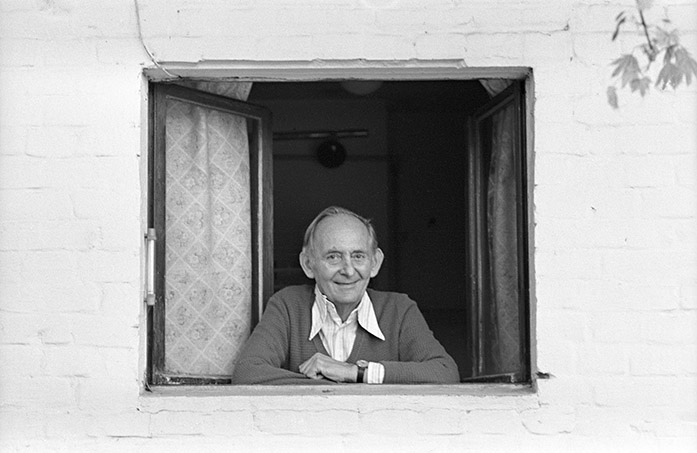
The house arrest of then 68-year-old Robert Havemann ended on 9 May 1979. The picture shows him at his house in Grünheide, outside Berlin.
The regime lifted the restrictions confining Havemann to his home in May of 1979. Shortly thereafter, he was fined 10,000 marks for having published in the West, in a trial instigated by the MfS. That did not stop him from publishing his “Zehn Thesen zum 30. Jahrestag der DDR” (Ten theses on the 30th anniversary of the GDR) in Western papers that very autumn. In this piece, he criticised the sections of criminal code providing for harsh penalties for the expression of dissent and called for an end to the prohibition of opposition in the Volkskammer, freedom of expression, the release of all political prisoners, an end to the censure, an independent news source, and the publication of his theses in the SED’s newspaper, “Neues Deutschland”, among other things. Much of this was also at the top of the lists of demands during the political upheaval in the autumn of 1989.
Havemann’s last book “Morgen. Die Industriegesellschaft am Scheideweg. Kritik und reale Utopie” (Tomorrow. Industrial society at the crossroads. Critique and real utopia) was published in 1980. In it, he took uncompromising stock of the social catastrophes and crises of the 20th century and argued that neither modern capitalism nor real socialism would be able to solve the global problems facing humanity. In the last years of his life, he supported the emerging independent peace movement, for which he was a source of valuable ideas and stimuli. In a letter written in July 1981, Robert Havemann and Rainer Eppelmann called on SED head and head of state Erich Honecker to demilitarise the life of society in the GDR and push for a nuclear-weapon-free zone in Central Europe as well as the withdrawal of all foreign troops. They never received a response.
Havemann sent an open letter to Leonid Brezhnev, the head of the CPSU, on 20 September of that same year. In it, he advocated the conclusion of peace and disarmament treaties ending Europe’s division into military blocs because “the division of Germany enables the emergence of the most lethal threat Europe has ever faced.” The letter was signed by a great many people in both East and West Germany. In late 1981, Robert Havemann and Rainer Eppelmann worked on the text of the “Berlin Appeal”, which took up these same calls and linked them with a call for democracy and de-militarisation in the GDR. The Berlin Appeal was published in January 1982, less than three months before Havemann’s death.
Robert Havemann died in Grünheide on 9 April 1982. Several hundred persons attended the funeral, despite a large Stasi presence there. The house in which he had lived was the venue chosen for the founding meeting of the New Forum (Neues Forum) 1989, at the suggestion of his wife, Katja.