

History of the Opposition in the GDR
Any history of an authoritarian or totalitarian regime is also a history of opposition and resistance. Whatever its intentions, a state with totalitarian ambitions will always provoke and produce resistance, which may be expressed in a wide variety of behaviours. In this context, proofs of loyalty to the regime offered up by the majority of the population, even over the course of decades, are not indicative of what the population is actually feeling. As the English historian Timothy Garton Ash noted in the late 1980s, while the leadership of the Socialist Unity Party of Germany (Sozialistische Einheitspartei Deutschlands, SED) was able (barely) to mobilise people’s bodies, it could not mobilise their hearts and minds. It is true, though, that those in the GDR who actively and openly resisted the pretensions of the “prerogative state” (Maßnahmenstaat) – who attempted to fight it and mobilise the society that had been deliberately immobilised by its rulers – were always in the minority.
Forty years passed between the post-war imposition of the Communist dictatorship and the revolution that ousted that dictatorship in the autumn of 1989. Though only a blink of an eye on the scale of world history, this was a lifetime for those living through it. Nobody is born a hero, let alone born to spend an entire life resisting all-powerful states. There are no textbooks that teach resistance and opposition. The only teachers for this are life and its vicissitudes and one’s own ethical foundations. The history of National Socialism provides a good illustration of this truth.
The greater part of German society was complicit in the Hitler dictatorship. As a result of the country’s earlier history (one that would have the gravest of consequences), democracy had developed only a few small saplings in German society by 1933. These were easily uprooted by the National Socialists. The Prussian state, with a mindset tuned to the authorities and their representatives, had prevented the ideas born of 1789 and 1848 from developing into a strong tradition by 1933, or at least from doing so on any broad scale. German society was not shocked when Hitler took power in 1933, far from it: the greater part of society welcomed the totalitarian state and would continue to support it for many years. Right up until the end of the war, in 1945, Hitler’s dictatorship was underpinned by the support, approval and loyalty or at least disgruntled acceptance on the part of a vast majority of the population. In fact, people did not begin to turn away from the regime in any significant number at all until 1941/42, when Allied air strikes began bringing the war and its destruction to Germany itself. Though more and more did begin to do then, those who openly voiced opposition or advocated sustained resistance to the system never made up more than a small percentage of the population.
In the first years of the Nazi dictatorship, 1933–1936, the little resistance that was expressed came largely from within the ranks of the two banned labour parties, the Social Democratic Party (Sozialdemokratische Partei Deutschlands, SPD) and the Communist Party (Kommunistische Partei Deutschlands, KPD). They paid a high toll in lives for this. Another factor keeping the level of resistance down was that many thousands of people who opposed the system left the country, fearing for their lives. While the Churches did offer some resistance to the regime, the extent to which those involved thought of this as political resistance was very limited. Initially, the (Protestant) Evangelical and Catholic Churches were primarily concerned about preserving their autonomy and avoiding state-occupation. There were also elements in both Churches that opposed the persecution of Jews. Political resistance decreased during the second phase of the dictatorship, 1936–1941, partly because arrests and emigration had substantially weakened the KPD and SPD and partly because the regime was riding on a broad wave of approval, which grew even stronger with the successes in the early years of the war.
After the invasion of the Soviet Union in 1941, the war’s impact on life in Germany gradually grew more severe, and a more broadly based resistance to the dictatorship began to take shape and develop. No longer confined to Communist and Social Democratic circles, it could now be found throughout much of society. There were resistance groups within the military and loose groupings recruited from bourgeois democratic circles or made up of people motivated by religious considerations. On the whole though, the people who engaged in political resistance to the Nazi regime never made up more than a small percentage of the population. At an estimate, around 10,000 of Germany’s citizens were active political opponents of the Nazi dictatorship.
This being the case, the German Communists, despite their totalitarian worldview, saw themselves as holding a sort of moral high ground in 1945, a view that large parts of the society accepted in the post-war period, at least at first. The Communists’ calls for the establishment of economic and societal structures that would prevent such a dictatorship from ever arising again met with widespread approval. However, once it became clear in the first post-war years that a new dictatorship, modelled on the Soviet Union, was being constructed, a variety of forms of resistance and opposition began to appear. Many people wanted a genuinely new beginning after their terrible experiences of dictatorship and war. The brutal use of police terror in the Soviet Occupation Zone and then the GDR, first by the Soviet occupying forces, then by the Soviet secret services and finally by the political secret police, provoked many forms of resistance against the Communist dictatorship, particularly in the late 1940s and early 1950s. In later years, the typical pattern was that resistance and opposition originated in persons who were themselves involved in the SED dictatorship or were at least seen as its supporters.
Although opposition and resistance shaped the societies of communist countries over the entire history of “Communism in power”, officially, they did not exist in those countries. They could not, because there was no objective or social basis for them. The regimes’ reasoning was quite simple: the ruling party ruled in the best interests of the entire people, hence any persons opposing the party must, viewed objectively, be acting contrary to the interests of the people. Prosecuting opposition figures in criminal courts was thus by no means a form of political repression. Opposition figures were branded “common” criminals.
Nonetheless, the 1950s were rife with opposition and resistance, as well as persecution, repression and convictions. The “people’s uprising” on 17 June 1953 seared itself into the collective memory of the East German population, members of the SED leadership included. The summer of 1953 made it glaringly plain to the SED leadership that a substantial majority of the population was negatively disposed towards communist rule, merely tolerating it. It also made the GDR’s leaders aware that their power base was entirely made up of Soviet bayonets. For its part, the GDR’s population was forced to realise, as the Polish, the Hungarians, the Czechs and the Slovaks would later be forced to realise, that the communists were going to remain in power as long as they remained able to summon “international assistance” from the Red Army.
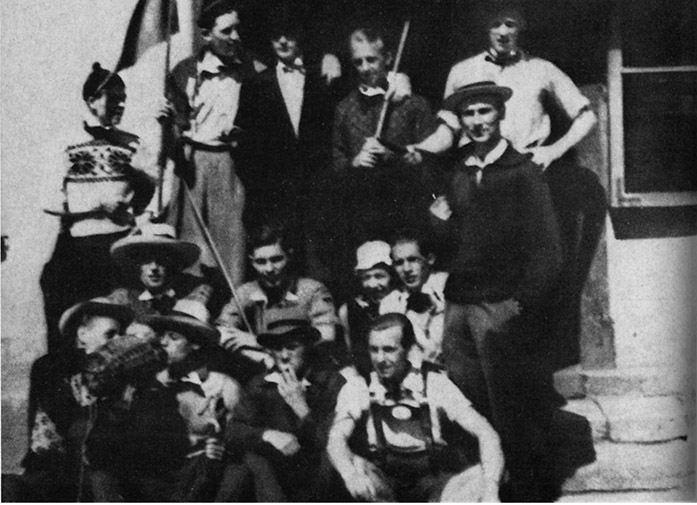
Early resistance at the University of Rostock: The university’s rowing group on an excursion on Ascension Day, 1951. Four of the people shown in the photograph would later be condemned by a Soviet military tribunal: Alfred Gerlach (1st row, 4th f. l., 25-year sentence), Otto Mehl (1st row, 3rd f. l., 25-year sentence), Karl-Alfred Gidowsky (2nd row, 4th f. l., death sentence) and Hartwig Bernitt (3rd row, 2nd f. l., 25-year sentence).
There is no single element common to all of the forms of behaviour expressing opposition or resistance or a critical attitude towards the regime in the history of the GDR. There was no dogma of opposition and resistance (Karl Wilhelm Fricke). There are considerable difficulties entailed in formulating coherent definitions for resistance and opposition and developing a typology of resistant behaviour, but one must at least draw a distinction between, on the one side, the social democratic, Christian and other groups of individuals in the late 1940s and the 1950s whose opposition to the ruling regime was fundamental and, on the other, the predominantly reform-oriented groups of the 1970s and 1980s. The former were groups hostile to the SED that consciously struggled against the dictatorship of the communist party and the Sovietisation of the Soviet Occupation Zone. They had contacts and sympathisers in the western part of Germany (in, for instance, the “Eastern offices” of the political parties (SPD, FDP and CDU), or in human rights organisations like the Investigative Committee of Free Jurists (Untersuchungsausschuss freiheitlicher Juristen) or the Fighting Group against Inhumanity (Kampfgruppe gegen Unmenschlichkeit). Seeking an end to communist rule, they aspired to parliamentary democracy and reunification. These groups were illegal right from the start, and their activities were, of necessity, clandestine. By contrast, the oppositional groups of the 1970s and 1980s were able form and develop in relative openness. These two basic patterns of resistant behaviour existed side by side in both phases, however, it was only their relative prevalence that changed: in the earlier phase, fundamental opposition was the prevailing pattern, in the next, the desire for reform. It should also be noted that the transition between phases was fluid.