

These independent peace groups would later split up into multiple separate groups focussing on environmental, women’s, or third-world issues or rejecting any form of military or alternative service. In conducting their activities out in the open, they were very unlike the opposition circles of the 1960s and 1970s, which operated along conspiratorial lines. Their aim was to call for open dialogue and to get their message across to the widest possible audience, and they used a variety of formats to do so, such as Peace Decades (Friedensdekaden), peace seminars, peace workshops, fasts, church services with blues music (Blues-Messen), samizdat or written appeals.
Even socialist dissidents, such as Robert Havemann, became linked with the peace movement. In late 1981, Havemann wrote an open letter to Leonid Brezhnev, the Soviet head of state, calling for an end to the confrontation between the blocs and urging that Germans be given back the right to self-determination. These efforts culminated in January of 1982 with the “Berlin Appeal” (Berliner Appell), drafted by Havemann and the Evangelical minister Rainer Eppelmann, which quickly attracted more than 2,000 signatories. This document called for the reduction of the militarization of East German society as well as an end to the confrontation between the blocs around the world. Similar demands were raised by groups with and without ties to a church, such as the Jena Peace Community (Friedensgemeinschaft Jena) or Women for Peace (Frauen für den Frieden).
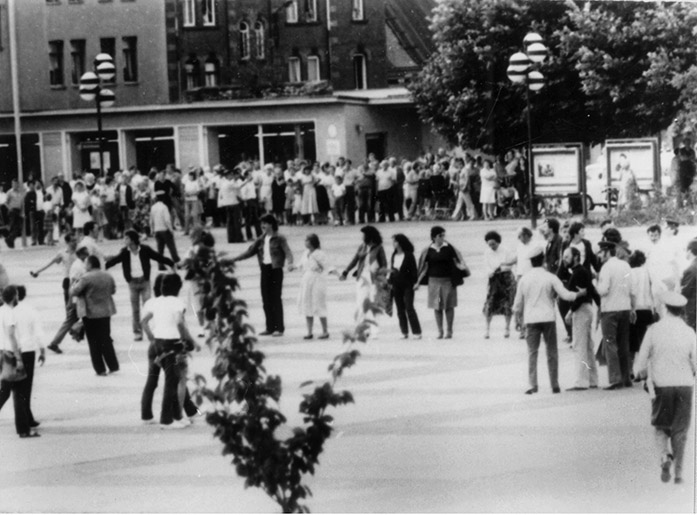
Protest in Jena: A group of would-be emigrants form a “white circle” on Platz der Kosmonauten, a public square in Jena, hoping to draw attention to their cause, 1982. Security forces swiftly intervened to put a stop to the demonstration.
Attempts to raise the issue of human rights begin in the mid-1980s – noticeably later than in other communist countries. Until then, discussion of this issue was limited almost exclusively to church congregations and dignitaries. In the mid-1980s, the IFM drew up a paper stating: “But our concept of freedom includes the notion of dealing with the causes of aggression and violence not only in international relations but also within the states.” These activists, like those in many other movements in Europe, felt that internal and external peace were two sides of the same coin. For the most part, the question of German unity was not addressed in this context. While there were some people outside the GDR, particularly in eastern Central Europe, who hoped that a resolution to the problem of divided Germany might lead to democratisation in their own countries, most opposition figures within the GDR itself assumed that the resolution of the German question could only be reached within “a common European home” with the participation of all European neighbours and of the superpowers.
The opposition had many faces in the 1980s. Those who were consciously political and understood themselves as “opposition” were, on balance, quite few in number and confined to a few regions and big cities. This group was already undergoing a process of increasing differentiation by the mid-1980s, rendering it impossible to speak of “the GDR opposition” in this period. In reality, the “GDR opposition” as a uniform block or monolith was never more than a fiction created by its adversaries, though one which, it seems, lives on in legend even today. One can find all sorts of standpoints, demands and views reflected in the programmatic declarations of opposition groups, the exception being any that advocated the continuation of the SED dictatorship. However, calling for an end to the dictatorship was not the same as calling for an end to the GDR. The democratisation of the GDR was seen as a step that must be taken before any resolution to the German question could be found.
The greatest differences among and within opposition groups concerned their views with regard to West Germany. While some groups, such as the Berlin-based groups Opposing Votes Gegenstimmen), Friedrichsfeld Peace Circle (Friedrichsfelder Friedenskreis) or the Environment Library (Umwelt-Bibliothek), did not want to join forces with Western parties that supported “brutal dictatorships like those in South Africa and Chile” in “shedding crocodile tears over the human rights violations in the GDR”, other groups, like the IFM, made targeted efforts to use the West German public to further their own work. This included seeking dialogue with all relevant political forces in the West.
Democratising the GDR, launching a discussion in society, breaking down ossified structures, challenging the SED’s claim to be the sole representative of the people, reforming the media, setting up transparent decision-making processes, securing the freedom to travel and respect for universal human rights in general, creating structures establishing the rule of law, and filling in the gaps in the historical record for the country’s recent past: these were among the most important aims of the opposition in the GDR. The non-dogmatic, non-Communist opposition, in particular, saw their mission as that of kick-starting processes and developments, not trotting out yet another set of ready-made models and structures. This is one reason for the absence of proposals for macrosocial alternatives and one reason why discussion of the German question tended to be marginalised on the whole. Moreover, the majority of opposition figures were sceptical vis-à-vis the state on principle, with some exceptions, such as those who would go on to found the Social Democratic Party in the GDR (Sozialdemokratische Partei, SDP – later SPD). Many people in the GDR harboured a profound mistrust of the state, its institutions and its monopoly on violence, a mistrust that was not directed solely at the GDR. Many civil rights campaigners grew less suspicious of the state after 1989, while others remained very distrustful; today, some of the latter are among the severest critics of former opposition figures who are now active within the established political parties.
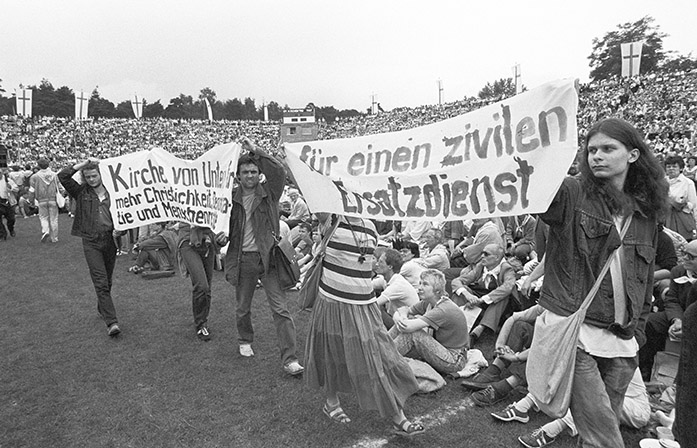
Church from Below (Kirche von Unten) protest event at the Evangelical Church Assembly in East Berlin, 28 June 1987.
At the latest by the end of 1987, no one, inside or outside the GDR, could deny the existence of an opposition movement in the country. In November of 1987, pro-opposition sentiment both in and outside of the GDR began to increase by leaps and bounds. Three things contributed to this: a series of large-scale State Security raids targeting opposition bodies that operated out of churches, public protests by civil rights activists and would-be emigrants that drew a lot of media coverage and the expatriation of prominent opposition figures. The pro-opposition sentiment had not died down by the autumn of 1989. The incubation phase that culminated in the civil movements of 1989 began in November 1987 at the latest, when the MfS occupied the Berlin Environment Library, seizing materials and arresting activists.
Starting in the early 1980s, a series of attempts were made, with varying degrees of success, to establish supra-regional alliances and networks of opposition groups (Frieden konkret, Solidarische Kirche, Kirche von Unten, Ökologisches Netzwerk Arche, Environment Libraries, anti-conscription groups). In March of 1989, the IFM launched a call for a nation-wide network. This was only moderately successful, but in the summer of 1989, several nation-wide groups did begin to coalesce, bringing together the most influential opposition organisations and figures.
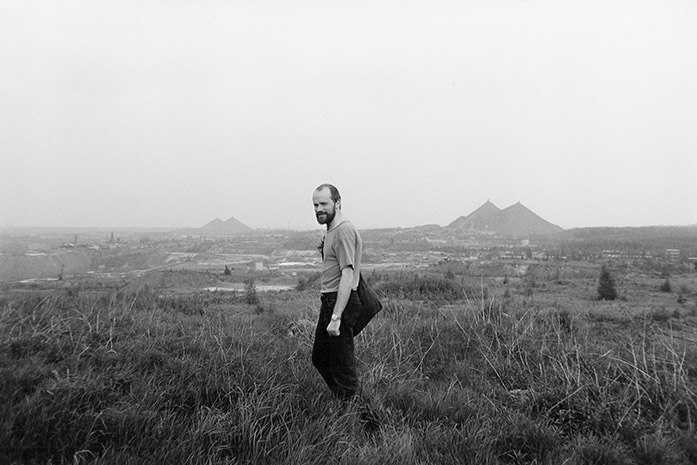
Michael Beleites on a property south of Ronneburg belonging to Wismut, a uranium mining company, in the summer of 1989. Beleites’ 1988 samizdat-published study “Pitchblende” cogently conveyed the environmental impacts of uranium mining in the Ore Mountains.
In 1988, the GDR’s domestic crisis began to escalate; the flow of people fleeing the country could no longer be stopped. Thousands of people joined the opposition, turning out to protest the banning of Soviet films and magazines, the expulsion of secondary-school students in East Berlin for making pacifist remarks, the electoral fraud in May of 1989 and the propaganda glorifying the suppression of the Chinese democracy movement in the GDR media. Internal differences within various groups gave rise to splinter groups, revealing the plurality of the opposition movement, which had been present all along, to the rest of the world in a way which allowed its specific features to be discerned as well. Starting in September of 1989, new civic movements, such as the New Forum (Neues Forum), Democracy Now (Demokratie Jetzt) and the Democratic Awakening (Demokratischer Aufbruch), took shape alongside the IFM, the Environmental Libraries and others. Later, even more associations and parties were formed: The Greens (Grüne Partei, later Die Grünen); the United Left (Vereinigte Linke), which grew out of a document known as the Böhlen Platform (Böhlener Plattform); the Independent Women’s Association (Unabhängiger Frauenverband); the German Social Union (Deutsche Soziale Union) and others.
For the most part, the people who were involved in forming the earliest of the new associations, such as the New Forum, Democracy Now, the Democratic Awakening, but also the Greens and the United Left, had years of experience in the opposition; many of them had already worked together in other groups or alliances in the past. But the associations that formed later, such as the Independent Women’s Association or the German Social Union, differed in this respect: many of those actively involved in them were long-term SED members or people who had, until the autumn of 1989, been politically conformist.
Initially, the New Forum, Democracy Now and the Democratic Awakening understood themselves as movements that embraced a variety of groups, movements open to anyone who wanted to take an active part in the democratisation of the GDR. By contrast, when the SDP formed on 7 October 1989, it did so explicitly as a political party, one that made no bones about its intent to challenge the SED’s claim to power. Already in its earliest documents, the SDP affirmed its commitment to the socio-ecological market economy, the rule of law, the separation of powers and parliamentary democracy.