

There were members of the Christian Democratic Union (Christlich Demokratische Union, CDU) and Liberal Democratic Party (Liberal-Demokratische Partei, LDP) who resisted the communist hegemony in the years of the Soviet Occupation Zone and who continued to do so in the early years of the GDR. Some resistance came from within the Catholic and Evangelical Churches as well. It would not be accurate to say that the regime’s persecution of the Evangelical youth organisation Young Congregation (Junge Gemeinde) in the early 1950s was in response to opposition from them, though: there, the SED was acting more out of the fear that independent spiritual authority might countervail its own authority. Jehovah’s Witnesses were the target of particularly severe persecution – as they had been during the Nazi dictatorship – starting with the banning of the denomination in 1950. Students at schools and universities were major agents of opposition and resistance in the 1950s: having experienced National Socialism, they did not want to find themselves defenceless in the face of yet another dictatorship.
Shortly after the SED was created through the forced merger of the KPD and SPD, social-democratic SED members began to engage in forms of resistance. It was not unusual for illegal groups of like-minded members to take shape within or outside the party. Even the several waves of “purges” were unable to eliminate resistance within the party completely, but between 1948 and 1950, a total of about 200,000 Social Democrats were expelled from the SED, more than 5,000 were arrested and several hundred lost their lives in internment camps, East German prisons or Soviet labour camps.
In the 1950s, continuity of opposition was further undermined, primarily due the influence of two factors. One was persecution by the SED, the Ministry of State Security (Ministerium für Staatssicherheit, MfS) and the Soviet occupiers. This was far more severe and savage during the 1950s than it would be after the Wall was built in 1961, and especially compared to the 1970s. The imposition of long sentences of penal servitude or imprisonment for relatively minor offences repeatedly tore holes in the ranks of the opposition. The other factor undermining opposition in the 1950s was the flight to West Germany of persons who were either facing imminent arrest or thought they might be. Flight became far more difficult and dangerous after 13 August 1961, and the building of the Berlin Wall. This marked the end of the period of relatively widespread fundamental anti-communist resistance in the GDR. To best grasp the extent of dissatisfaction with the regime, one should look at the numbers of people who fled East Germany: between 1950 and 1961, approximately 2.6 million of the GDR’s citizens fled to the FRG. To put this figure in context: the average population of the GDR in this period was 17 million. This stream of people out of the country permanently weakened the opposition.
In the pre-Wall period, the prevailing attitude towards the regime was one of clear rejection, and even the socialist opposition was in favour of a unified Germany. After the border was sealed, though, the opposition moved into “pre-political” fields and spheres of action. Although the regime refined the forms of its repression after 1961, ostensibly discarding the more brutal methods (social/psychological “decomposition” measures – “Zersetzung”) became the principal method), the GDR took on far more distinct features of an Orwellian surveillance state in this period than it had evinced before 1961. Politically aware and active opposition in the GDR was limited to a few thousand persons. Nonetheless, there were always thousands of people serving sentences on political charges. Over the course of the GDR’s history, more than 250,000 people were incarcerated on such charges.
Through to the mid-1970s, the political opposition was made up largely of two groups. One was that intellectuals who still adhered to the socialist idea, who tended to engage in clandestine activities, with the result that they had little impact outside of their own circles. The second group was based in the Evangelical Church, some of whose officials opposed the dictatorship for theological, theoretical and sometimes also practical reasons rooted in their Protestant viewpoints. The majority of the population either lived dissatisfied but conformist lives or, if they attempted to build lives based on self-determination that resisted the prescribed norms, did so without articulating this politically.
In the period between the building of the wall in 1961 and late 1976, when Wolf Biermann was stripped of his citizenship, opposition tended to manifest itself as cultural opposition. A tendency to withdraw from the state and society set in, above all among young people. People sought to take back control over their own destinies and test the limits of the dictatorship by trying out and engaging in new ways of living. Unrest and demonstrations associated with beat/rock music concerts harked back to the unrest associated with jazz and rock’n’roll in the 1950s, a phenomenon seen in Western Germany and the USA, as well as in the GDR. There, though, jazz or rock’n’roll fans were sentenced to long sentences of penal servitude for having abetted “American cultural imperialism”.
A great many forms of protest appeared in the GDR in connection with the *Prague Spring in 1968. These ranged from refusal to obey orders in the armed forces to the distribution of home-made flyers, from short, spontaneous demonstrations to refusing to sign the declarations approving the *invasion of Czechoslovakia by Warsaw Pact troops. Criminal courts prosecuted nearly 1,200 people for protesting the invasion, 75 per cent of them under the age of 30. Over 84 per cent were workers. In fact, quite unlike the situation in the 1950s, when students and intellectuals were among the most active members of opposition groups, secondary or university students were something of an exception in the political opposition in the period after the wall was built. Political selection and social corruption were operating far more effectively in the later period.
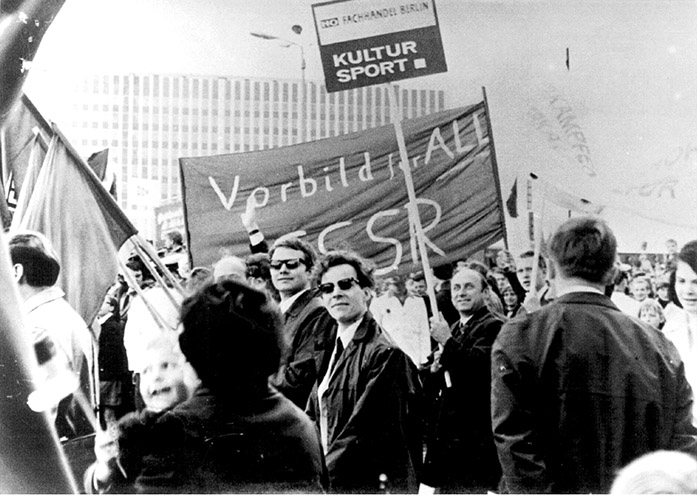
A great many people in the GDR expressed solidarity with the ideas of the *Prague Spring in 1968, like those shown here at the central demonstration celebrating International Workers’ Day (1 May) in East Berlin. Both of the men holding the poster were arrested by State Security shortly after this photograph was taken.
Several years in the GDR’s history can be singled out as having had particular historical significance. Among them are 1953, 1961 and 1989. With respect to the history of resistance, 1976 is certainly another one. In August of that year, a Protestant minister named Oskar Brüsewitz set himself on fire in protest against the SED dictatorship. This act of self-immolation shook the relationship between church and state to its foundations. Also, in November of 1976, Wolf Biermann was stripped of his GDR citizenship while he was giving a concert in Cologne, and this proved an important catalyst for the formation of a new opposition.
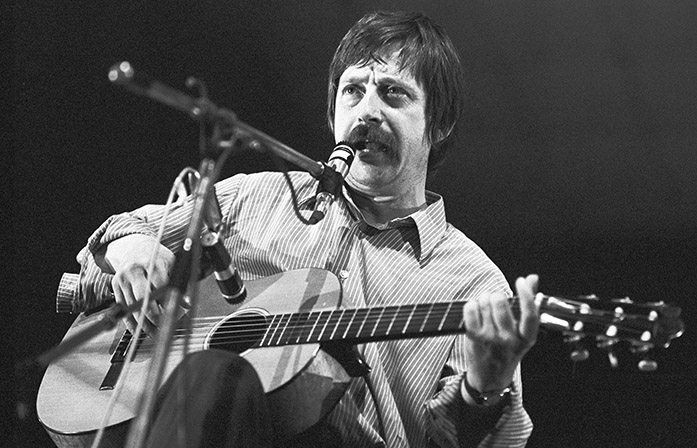
Singer-songwriter Wolf Biermann at a joint concert given by expelled GDR artists at Eissporthalle (an ice rink) in West Berlin on 4 November 1977. Appearing with Biermann were former Renft-Combo members Gerulf Pannach and Christian Kunert, who were stripped of their citizenship in 1977.
Political events and developments outside the country at around this time also had a catalysing effect, particularly the signing of the Helsinki Final Act of the CSCE in 1975, the founding of the civil rights movement *Charter 77 in Czechoslovakia, the 1979 Soviet invasion of Afghanistan, the activities of *Solidarność in Poland starting in 1980 and the developments in the Soviet Union and Hungary from the mid-1980s onward.
After the denaturalisation of Wolf Biermann, critics of the regime in the GDR could usually be described as either stayers (Hierbleiber), or those who wanted to leave (Wegzügler). While the latter meant to emigrate to West Germany as soon as they could, those in the first group wanted to create a place for themselves within the GDR and set up their own, functioning, political structures. Making it to the West posed the more immediate difficulties, but the path of the “stayers” ultimately proved to be the far more complicated, dangerous and paradoxical of the two.
In the late 1970s, peace groups began to form in many Protestant congregations in response to the increasing militarisation of society and the global arms race. People who did not belong to a church also joined these groups. Relations between these groups and the Church hierarchies was not always free of tension because Church leaders wanted to maintain good relations with the political leadership. However, the peace groups did receive support from a number of critically inclined ministers, deacons and church employees. The call for the creation of an alternative civilian service was very important for these groups in the early years. This demand (left unmet until 1989) was raised mainly by men who refused to perform military service or construction soldiers (Bausoldaten), men who elected to do their military service in non-combat units.
The 1980–1982 protest movement “Swords into Ploughshares” (Schwerter zu Pflugscharen) went down in GDR history as the largest mass-opposition movement after June 1953. It transcended the boundaries of the Churches and intensified the conflicts between Church leaders and independent groups. This pro-democracy movement, which condemned the arms race and militarisation, took its symbol from the biblical image of the smith who beat his sword into a ploughshare. Ironically, the Soviet government had presented a sculpture to the United Nations depicting this very image in 1959. A photograph of this sculpture, which still stands at the UN headquarters in New York, was even reproduced in the official GDR books published to mark the “Jugendweihe”, a secular coming of age ceremony. However, when the symbol began to be distributed, in the form of a patch, by the independent peace movement and be openly displayed by well over 100,000 critically inclined young people, the party leadership and the state security apparatus took drastic action, de-facto banning the display of this global symbol for peace.