

The civic movement underwent further differentiation during the rapid and turbulent changes that began when the wall came down on 9 November 1989. In this same period, several associations entered into electoral alliances with a view to the elections to the Volkskammer (the unicameral GDR legislature) to be held on 18 March 1990. Key achievements of the opposition after the fall of the Wall include the dissolution of the MfS, the installation of the Central Round Table (Zentraler Runder Tisch) and critical investigation of the history of the GDR, which continues to this day. The enactment of the Stasi Records Act (Stasi-Unterlagen-Gesetz, StUG) remains the most visible achievement of the civic movements.
From the perspective of the civic movements, the results of the Volkskammer elections were ambivalent. The classic groups, such as the New Forum, Democracy Now and the IFM, which had joined forces in an electoral alliance called Alliance 90 (Bündnis 90), were able to send only a few representatives to the first and only freely elected Volkskammer (having won only 2.91 per cent of the vote and twelve seats in the legislature). The electoral alliance formed by The Greens and the Independent Women’s Association won 1.97 per cent of the vote (8 seats). The Unified Left sent one representative to the Volkskammer. However, there were representatives of the opposition both in the Democratic Awakening and in the SPD, which formed part of the coalition government after 18 March, filling ministerial posts. With this election, the history of opposition and resistance in the GDR came to an end.
If there was one constant element running through the history of GDR opposition from the immediate post-war period to 1989/90, then it was the call for democratic elections. All resistance groups voiced this call, right from the beginning. They differed, in some cases considerably, over numerous other social and political aims and above all in their views on how such aims should be achieved. Nonetheless, it does not seem too great a leap to see the opposition activists from the 1940s and 1950s as early insurgents in the Peaceful Revolution of 1989. Many of the aims of the failed revolution of 1953 were, unexpectedly and belatedly, fulfilled through the successful revolution of 1989.
Moreover, while it is basically correct that resistance was primarily anti-Communist and fundamental in nature in the 1950s and from there grew increasingly reform-oriented in a process continuing into the 1980s, influenced by the changing international situation, it is nonetheless important to note that there a broad reform-oriented opposition did exist already in the 1950s and that there still was an anti-Communist fundamental resistance in the 1980s, one that was not opposed to the use of violence against property and persons. A well-known case in point is that of Josef Kneifel, who, late in the evening of 9 March 1980, tried to blow up the Tank Monument in Karl-Marx-Stadt (Chemnitz) with an explosive device he had built himself. Kneifel, who had been sentenced to a ten-month prison term in 1975 on political charges, was protesting Soviet intervention in Afghanistan and the continuing Soviet occupation of the GDR. Kneifel was sentenced to life in prison for the attack on the tank and served seven and a half years before the West German government was able to buy his freedom. The archives of the MfS detail many similar acts of resistance; a systematic review of these records is still necessary.
Most of the aims of the opposition relating to the political system of the GDR were rendered obsolete by the revolution of 1989. This is not to say that they were all realised. Still, the most important of them were achieved: guarantees of free and open debate and the possibility of activism in the cause of a civil society without fear of reprisal, the further development of democracy and the establishment of the rule of law. It is true that there are other opposition aims that remain unmet, causes that are still worth arguing and struggling for, such as – here only the catchwords: demilitarisation, the environment, the gender issue, social injustice, immigration and minority issues, North/South divide, secret services, etc. However, and this is the key difference, the constitutional democratic state provides a plethora of ways and means through which people can draw attention to problems like these, make them a subject of public debate and gradually arrive at solutions for them.
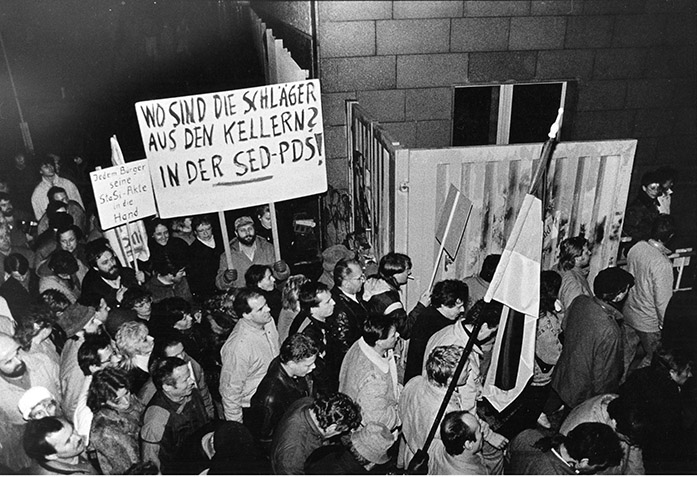
Storming of Stasi headquarters on 15 January 1990: Starting in early December of 1989, a number of district or local offices of the State Security Service were occupied by civil rights activists. On 15 January 1990, the New Forum called for people gather in front of the Stasi headquarters in East Berlin for a demonstration. Tens of thousands answered the call and occupied the building. As had happened elsewhere, a citizen’s committee formed to prevent the destruction of the files and help bring about the dissolution of the State Security Service.
While it is especially important to emphasise that the opposition to Communist dictatorship became not merely irrelevant but also a thing of the past upon the demise of that dictatorship, it is equally important to note that this in no way diminishes the value of the subjective experiences of those involved in the opposition. Quite the contrary: knowing that one not only lived under the conditions of a dictatorship but also defended oneself against them, should help one to defend and actively assert the civil courage and confidence that are still needed today. These personal experiences directly contribute to strengthening and consolidating the anti-authoritarian consensus. They should be passed on, as they contain a warning about the dangers of totalitarianism that must be kept alive.
We in Germany cannot and must not ever behave as though German totalitarianism had never happened. Twentieth-century Germany experienced two quite different forms of totalitarian dictatorship. In urging people to remember these, we must also warn of the danger that yet another form may arise, one whose specific features cannot be foreseen. It is crucial to make use of these experiences and clearly convey them to others through education. There are many reasons why this is so. One is that they offer a way to draw attention to the many dictatorships that are still in existence today and can inspire people to take action against them. The myriad experiences people had to endure along the road from an authoritarian state to a democracy provide vivid testimony that human rights must never be taken for granted, anywhere in the world. Moreover, a democratic system is not a rigid system whose continuing existence, once established, is guaranteed, any more than a totalitarian system is.
Democracy is not merely a way of structuring a state and society: it is, first and foremost, a way of life, a way of viewing and shaping the world. Each new generation has to learn this all over again. Thus, to enable future generations to learn this lesson is another reason that these experiences must be passed on in a way that conveys their full dimensions, and certainly not that of least importance: these experiences can foster, strengthen and protect the democracy.